Are Georgia Elections Honest and Secure?
First, we need to be clear about what we mean by “honest and secure elections.” An honest and secure election is an election in which all ELECTORS (people who are eligible to vote), BALLOTS, and COUNTS are processed and handled properly and accurately and securely at all times, before, during, and after the given election, and for all issues occurring in regard to all of the above, proper and independent ENFORCEMENT of all election laws and processes are ensured.
Anyone who knows how our current voting system works would immediately recognize in the above definition of “honest and secure elections” that we currently DO NOT HAVE ELECTION SECURITY.
In order to better understand what we need, but do not have, let us consider how each of these four voting factors (ELECTORS, BALLOTS, COUNTS, ENFORCEMENT) should work:
Electors
Prior to each election, a complete list of electors who are eligible to vote in the next election must be established and maintained by each county for the given election. The county election officials must ensure that every qualified eligible elector in the county who has registered to vote prior to the beginning of the next election cycle is on the official elector registration list and all information in their registration record is validated properly as a prerequisite to the creation of their registration record. No other registration records are allowed on the list (i.e. records not uniquely associated with a known qualified eligible elector).
The registration record of any elector who no longer qualifies to vote (e.g. persons who died, persons who changed residency to a different county or state, persons convicted of felony, etc.) must be removed promptly prior to the start of the next election cycle.
Official copy of the Elector Registration
At the designated time (e. g. 90 days) prior to election day, an official unalterable copy of the elector registration list must be created and made available on the given county website, prior to the given election, for inspection and download by any citizen of Georgia at no cost.
Each county must also provide the complete county registration list to be used for the given election to the office of the Georgia Secretary of State, which must provide the complete state-wide or partial state-wide aggregated list on the state website for inspection and download by any resident at all times and at no cost. This official unalterable copy of the elector registration list must be used during the election period (i.e. for each day of early voting, and for election day).
Under no circumstances can this unalterable elector registration list, once created, be altered at any time before, during or after the given election. This unalterable list must be preserved unaltered along with all other public records for the given election, for at least for two years after the given election, or until after the start of the next election cycle, whichever is longer.
Election Officials Accountability
Failure to properly maintain a “clean voter roll” registration list for any given election is grounds for automatic termination of employment for any and all responsible election officials in the county.
In order to hold such election officials accountable, each election worker who has the authority to modify the county elector registration list must always access this list using unique log-in credentials, and all such log-ins and changes must be tracked in a secure log file, so that any and all such log-ins and registration file changes can be easily tracked and attributable to the individual who actually made the changes. No sharing of log-in credentials is allowed.
Ballots
All ballots for each election must be produced using specially designed paper with special unique watermarks and other useful features to prevent counterfeiting.
Each such ballot used in a given election must be easily identifiable as a Georgia ballot, and the county name and precinct code must be marked and clearly visible and readable on the front of each ballot, along with the date of the given official final election day. Only ballots with the correct precinct level identification and date can be used at a given precinct for a given election.
Voter History List (paper)
During each day of the election period, including all early voting days and election day, every elector who casts a ballot in-person (i.e. the voters) must be listed on the official paper in-person “voter history list” established each day of voting for the given precinct. This list must include the county name and precinct code and current date, along with an enumerated list of voter names, with each such voter name placed in the next available line, starting with the first, so that at any time, any poll worker or poll watcher can see how many electors have received a ballot on the given day.
This in-person “voter history list“ must exist on paper and be maintained separately from any electronic list of electors or voters (i.e. electors who actually voted in the given election).
Poll and manager and duties with the voter history list
Furthermore, at the close of the polls of each day of voting, the poll manager must circle the last voter name on the voter history list, and cross out any remaining empty lines on the page. The poll manager followed by each poll worker must sign their name immediately in the designated area on the bottom of the last page. Also, each such poll worker must also write in next to their signature, the total count of voters enumerated on the list. This voter history list must then be sealed (never changed again), and then immediately thereafter, posted in the precinct in highly visible place from outside the precinct, and posted on the associated county website for inspection and download by anyone at any time, at no cost.
What’s on the Ballot
Each ballot received by each in-person or absentee voter must properly list all candidates for each position, along with a “NONE OF THE ABOVE” option for each position, in case the voter does not approve of any of the qualified candidates on the ballot. A distinct mark indicating the candidate chosen for each position made by the given voter should be clearly visible.
Ballot Box
“A ballot box is a closed and sealed container into which voters deposit their ballot papers.” POLYAS
Each ballot box must be confirmed to be empty at the start of voting each day. All completed in-person ballots must be properly placed or scanned into the official and secure ballot box, in clear view of poll workers and poll watchers. The voting ballot boxes or scanners must be video recorded (without view of actual voting booths), at such resolution so as to see the ballot box or scanner at all times but not able to read the text on any ballots.
Absentee Ballots
All absentee ballots must also be securely transported to the correct precinct in which the given absentee voter resides, prior to election day, in order to be opened and counted on election day for the given election. All such absentee ballots must be securely maintained and unopened until after the closing of the polls on election day. No-excuse absentee ballots should be prohibited by law in all Georgia elections.
Counting
At the end of in-person voting each day, when the polls are closed, all the ballots must be retrieved from all ballot boxes or scanners and counted and summed immediately after the end of voting, in the presence of all poll watchers. This paper ballot count must be recorded and compared to any recorded machine counts and to the total number of voters recorded on the completed in-person voter history list with the poll manager and all poll worker signatures.
Any discrepancy between the total number of physical ballots, the total number of voters, and the machine totals, must be documented. All of these total numbers must immediately thereafter be posted on the county website and made available for inspection and downloading by any person at no cost for at least the next two years.
When and Where to Count Ballots
The counting of all absentee and in-person votes for each candidate (including the NONE OF THE ABOVE counts) for each position must be performed on election day, at the precinct in which the in-person ballots were cast. The counting process must begin as soon as possible after the closing of the polls and the voter history list is completed and sealed, and the paper ballot count is completed and reconciled against the voter history list and machine ballot counts.
Processing Absentee Ballots
The unopened envelopes containing absentee ballots should be processed before absentee ballots are combined with the in-person ballots for counting votes.
First the unopened absentee ballots should be validated. The voter information on the envelope should be validated as being that of an eligible elector listed on the official unalterable elector registration list for the given precinct, and that voter verified as not having already voted. Any issues must be documented and any suspect or invalid unopened envelopes must be kept separate for further investigation.
For each validated unopened absentee ballot, the absentee ballot should be removed from the envelope, and combined with the uncounted in-person ballots, in such a manner that no one can ever associate the paper ballot with its absentee ballot envelope, to preserve anonymity. The empty envelopes must be placed in a secure container and kept separate as part of the official election documents for the given precinct for the given election.
Absentee voter history
For all such validated absentee voters, the voter name should be added to the paper absentee voter history list in enumerated order, with poll manager and poll worker signatures immediately following the complete list of absentee voter names. Under no circumstances can the absentee ballot envelopes be reunited with their associated absentee ballots.
Next, the counting of all ballots should be performed at each precinct as follows:
Under no circumstances can any ballots be moved or counted away from the clear view of poll workers and poll watchers. All poll watchers must have complete freedom of movement to witness the counting process, so long as they do not interfere in any way.
Ballot batches
The combined uncounted (both in-person and absentee) paper ballots should be bunched together into batches of 50 (or less for the last batch). Each such batch must be given a unique batch number. The batch number along with the count of the number of ballots in the given batch must be written on a piece of paper which must stay connected with the given batch of paper ballots, bound together with a rubber band or some other secure way at all times.
Each batch is then given to a “batch counting team” of poll workers, along with a new paper tally sheet on which must be written, the county name, precinct code, election date, the batch number, along with all the names of team members and their role assignments, consisting of four poll workers with roles as follows: (1) a ballot grabber; who hands the next uncounted ballot to (2) a ballot reader, who reads out loud (witnessed and confirmed by the ballot grabber) the chosen candidate for each position on the ballot; to (3) a tally sheet recorder, who marks the tally sheet for each candidate chosen on the ballot; which is witnessed and confirmed by a (4) tally sheet watcher.
Tally Sheet
Once all the ballots in a given batch are processed, the totals for each candidate are summed up on the tally sheet, and the total from all the candidates and “none of the above” votes is confirmed to be 50 (or less in the case of the last batch).
The completed batch of ballots, along with the completed tally sheet signed by each batch counting team member, is then given to the central vote count accumulation team, by a designated runner for the batch counting team, so that the batch counting team can immediately process the next available batch.
Vote count team
The central vote count accumulation team consists of a (1) batch count reader; who reads the results our loud to a (2) batch count writer, who adds the batch count results into an electronic spreadsheet on a computer, the screen of which is projected onto a large wall screen that any poll workers or poll watchers can clearly see at all times during the counting process.
Ballot Counting and Posting
As soon as all the counting results are done, all these results should be posted on paper inside the precinct polling location, in a highly visible location that can be seen from outside the polling location at least until after certification. In addition, the results must be immediately posted on the county website for all to inspect and download at no cost for at least 2 years or until the next election cycle, whichever is longer.
Since each precinct will have approximately 2000 electors or less who will be assigned to vote at the given polling location, and since not everyone votes, there will typically be around 1000 or fewer ballots to be counted, and at most about 2000 ballots to be counted.
Therefore, the amount of time required to perform this ballot count at each precinct should be well under 6 hours. And if the poll workers are assigned to 6 hour shifts, the first shift from 7am-1pm, the second shift from 1pm-7pm, when the polls close, and the third shift from 7pm-til done counting, then the time burden on poll workers will be more reasonable (unlike the current 12 hour shifts for poll workers).
The key point is that all the counting be performed at the precinct on election day, starting as soon as the polls close at 7pm.
Enforcement and oversight
Each individual member of the Board of Registrations and Elections (BRE) for each county, and each individual member of the State Election Board (SEB), must at all times have full access to all election data and records in order to be able to provide proper oversight of elections. In addition, the SEB must be empowered to be fully independent and properly funded.
Monitoring by a Grand Jury
Furthermore, since election officials are unlikely to enforce the law against themselves, and election board members are unlikely to enforce the law against those who appointed them, a special grand jury in each county involved in the given election, selected randomly from the county jury pool, should be seated for the specific task of monitoring the given election in the given county. The grand jury must be impanelled prior to the beginning of the election cycle, and continue all during the election period and after the election at least until the election certification process is complete. During this time, any person should be able to anonymously submit claims and evidence of election issues directly to the grand jury through the county web site, at no cost to the person making the submission.
Investigation of Complaints and Election Certification
The grand jury should investigate all such complaints and review all election and certification records, and should publicly release a final report detailing all complaints received, along with the investigation details including identifying the total number of issues associated with each such complaint.
The election certification process should not be allowed to end at least until the grand jury has completed and reported its findings of all known election issues. Each unresolved issue encountered during the counting process must be documented as to the nature of the issue, and the total number of vote discrepancies associated with the issue, if any. All such reports must be submitted to the county BRE, the SEB, and the special county grand jury, and if the total of all identified vote discrepancies matches or exceeds the margin of victory for a given position, then the election for this position must automatically be nullified and a new election for all such positions must be ordered to take place as soon as possible.
Accountability
Finally, any and all election workers and officials must be held fully accountable for any failures, intended or not, based on the findings of the county grand jury. Any and all election officials found to have failed to perform their job properly must be automatically terminated and forbidden to ever again be employed in any Georgia elections.
In addition, any election worker who is indicted by the grand jury must be prosecuted promptly, and if convicted, must be fined and confined according to law, with all such fines being a personal obligation rather than paid by the county or state. Finally, no such criminal sentencing should prevent any citizen from taking civil action against the county or state, for harm caused for failure to properly conduct elections and obey our election laws.
Secure our elections now
This, my friends and fellow citizens, is how to secure our elections in Georgia. If you agree with any or all of the above, and want our legislators to pass such legislation to SECURE OUR ELECTIONS NOW, then you can visit MY VOTER PAGE online to find out who your state legislators are. You can then contact them at LEGISLATOR CONTACT LIST or visit them down at the state capitol to petition for a redress of your grievances.
Since this is what honest and secure elections look like… it is crystal clear that WE DEFINITELY DO NOT HAVE HONEST AND SECURE ELECTIONS HERE IN GEORGIA (see VOTERGA website for more information about the problems with our election voting system in Georgia).
Now is the time to act
The Georgia General Assembly is now in session. The fact that we do not have “honest and secure elections” in Georgia is an utter disgrace, and there is absolutely no excuse for any state legislator as to why they are allowing this disastrous situation to continue for even one more election.
Our Founding Fathers held our right to vote as sacred.
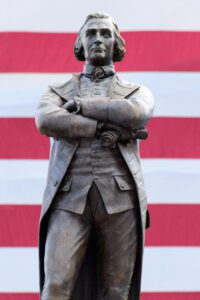
“Let each citizen remember at the moment he is offering his vote…that he is executing one of the most solemn trusts in human society for which he is accountable to God and his country.” Samuel Adams
Regardless of whether or not you believe any given election has actually been stolen, the fact that OUR ELECTIONS ARE NOT SECURE means that we cannot know for sure whether any of our elections are rigged or not. Thus we cannot trust the results of any election until the changes are made to make our voting system secure. Every citizen should be outraged by this regardless of their political affiliation.
What is at stake
What is at stake here is the very foundation of our American System of Government… that government power is derived from the consent of the governed. Without honest and secure elections we have no real representation, and hence we are no longer a functioning republic.
That to secure these rights, Governments are instituted among Men, deriving their just powers from the Consent of the Governed.” Declaration of Independence
If we complain without taking action then we are part of the problem. The Left and Right need to act in unison on this issue. Every American should be petitioning all state legislators every day until our voting system is made secure as per above.
Please call, write, and visit the State Capitol NOW, while they are still in session, to insist to our public servants that they do their job to SECURE OUR ELECTIONS NOW.
To meet like minded citizens, click HERE