What’s in the Library? – Senate Bill 74

Early exposure to sexually explicit or pornographic material can harm young children. This proven concept seems logical, well-founded, and sensible – not one that should require discussion or create divisiveness. There are even laws against exposing minors to pornographic material.
Yet, because of a loophole, public and school or university libraries in Georgia are exempt from the ban on distributing obscene media to people under 18.
To be specific, this exemption for libraries and librarians stems from a Georgia code enacted in 1984. (Code Section 16-12-103)
A bill to repeal the exemption – SB 74
A bill is now moving through the Georgia state legislature to repeal that exemption. It’s Senate Bill 74, sponsored by Sylvania Republican Sen. Max Burns.
SB 74 passed a House subcommittee on Tuesday. And, as usual, any discussion of repealing the library exemption sparked heated debate. Georgian librarians came out in force to deny the perception that they distribute pornography to minors.
Mikayla Arciaga, Georgia advocacy director at the Intercultural Development Research Association, voiced concerns that passing references to LGBTQ in books could lead to unwarranted accusations of obscenity.
Senator Burns’ response was measured and sensible. He stated, “I recognize that there are some really strong emotional positions.”
“At the end of the day, the objective is to protect Georgia’s children”.
“The objective is to ensure that the materials that could be harmful or obscene are placed in adult sections.”
“This is simple reality that says ‘I’m responsible to protect children.’” Senator Burns
Pornography library loopholes across the country
The library loophole isn’t just Georgia law.
38 states have the obscenity exemption. 12 do not.
Seven states never implemented this “obscenity exemption”. They are:
- Alaska
- Arizona
- Colorado
- Oklahoma
- Missouri
- New Jersey
- Rhode Island.
As of 2025, five states have repealed their exemptions (similar to what SB 74 seeks to do). They are:
- Arkansas
- Indiana
- North Dakota
- Montana
- Tennessee.
Reversly, 12 states have passed legislation to prevent perceived “censorship” in schools and public libraries. (In other words, disallow curation for pornography) They are:
- California
- Colorado
- Connecticut
- Illinois
- Maryland
- Massachusetts
- Minnesota
- New Jersey
- Oregon
- Pennsylvania
- Vermont
- Washington.
Numerous attempts to remove books by concerned citizens, because of content, were halted by these states’ laws.
American Library Association VS Parents
Over the years, on the national level, there has been a continuous swirling debate centered around the placement of obscenity and pornography in our school libraries. The debate is primarily parents’ concerns VS anti-“book-banners” arguments- fueled primarily by the American Library Association.
The sides are often wildly divided, with the two parties not even speaking the same language. Questions asked in the parental vernacular are often answered with ideological jargon.
Curate VS “Book Banning”
Parents want to curate content sensibly. In American Library Association jargon, there is no such word as “curate”; only “censorship” and “book banning’.
Parents are concerned about their children’s sanity, and the American Library Association talks about children’s “rights”:
“Library policies and procedures that effectively deny minors equal and equitable access to all library resources available to other users violate the Library Bill of Rights. The American Library Association opposes all attempts to restrict access to library services, materials, and facilities based on the age of library users. Amended 2019”
One article declares that when it comes to the desire of parents to curate their children’s reading material, parental rights is a misnomer which aims to “ultimately grant some parents the ability to circumvent the expertise of educators and librarians.”
What is going on here?
American College of Pediatricians
Though it does not take a degree in psychology to conclude that adult material is inappropriate for children, plenty of professionals have weighed in on the matter,
The American College of Pediatricians warns that:
“Children suffer many negative effects due to modern society’s exposure to and acceptance of pornography. These negative effects include mental disturbance and unrest for the young school-age child, including acting out and violent behavior. Sadly, pornography can contribute to the sexual abuse of children and the sex trafficking of children and women….
Because of its harmfulness to children, pornography must never be used as a tool to teach children human sexuality.” American College of Pediatricians
A randomized controlled study, cited in the same paper, revealed troubling outcomes for the group that participated in viewing pornography. Here are just a few examples:
“Male subjects demonstrated increased callousness toward women.”
“Subjects considered the crime of rape less serious.”
“Subjects showed a greater acceptance of female promiscuity.”
“Subjects became more interested in more extreme and deviant forms of pornography.”
Mental Health Implications
It is not far-fetched to suggest that the exposure of a child to pornography in a library could lead to mental disturbances and acting out, which in turn could easily lead to “labelling” and medication.
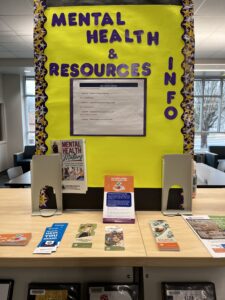
Oddly and paradoxically, in public libraries in the Atlanta area, there have even been signs posted advising how to get help for mental health problems. (This picture was taken in a College Park Public library.)
Taking Concerned Parents to Task
What is the American Library Association response to parental concerns?
The ALA has instructions on one of its websites on how to engage through social media and show up at school and library board meetings to “speak as a library advocate”.
In other words, it is a strategy to take concerned parents to task.
Glib ideology
Furthermore, the American Library Association and the Gay, Lesbian, Straight Education Network fight back against parental common sense with glib, sometimes well-articulated arguments, surrounded by a veil of ideology – but a complete look reveals no facts, no studies – just emotion, justification, and opinions.
Absurd Conflation
There is even an attempt to conflate their attempt to expose children to pornography as a staunch defense of the Bill of Rights and “democracy.” One article even purports that their views align with what our founding fathers had in mind.
The machinations around the asserted rights of librarians to expose children to pornography are symptomatic of a profession gone mad. Many librarians seem to have forgotten their role as custodians of knowledge for the civilization they serve.
What is a Librarian?
Librarians have existed since man learned to write. It was (and is) the job of librarians to protect, organize, and store written information so it can be accessed by citizens and preserved for future generations. Early librarians were called “men of the written tablet” by the Assyrians.
An article from Wikipedia entitled “Librarian” is rich with the profession’s history throughout the centuries. Here is just one excerpt that puts today’s library shenanigans in perspective:
“John Dury is considered to be the first English library theorist. He wrote two letters to Samuel Hartlib concerning the duties of a professional librarian, which were published in 1650 as “The Reformed Librarie-Keeper.” He held that librarians should not only care for the books but should also be well educated and accomplished to raise the standards of librarianship. …. Gottfried Leibniz upheld that:
the librarian was the most important factor in the aid of learning….”
It makes one almost feel sorry for our modern-day librarians.
What Should be in the library?
While there is plenty of discussion about what shouldn’t be in our school libraries, where is the research on what should be? Are those librarians so eager to promote the Bill of Rights and “freedoms” even aware of the history behind these divine rights?
Classical Traditions
Had our librarians been educated in the true history behind the Bill of Rights, there would have been a discussion about placing books that align with the classical tradition our founding fathers were educated in—a tradition that goes back 2500 years to the age of Pericles. It is based on the idea that it was the culture’s duty to educate its citizens in certain traditions so that they could sensibly give back to the culture. Cultures endure through knowledge. And that knowledge is in libraries.
Sadly, ridiculous distractions have kept us from the discussions we should be having about our school libraries.
Groups that are doing something
Fortunately, several good groups with members have risen above the clamor and can still think, trying to point the way to better reading and education.
For example, Freedom in Education (freedomined.org) and Rated Books have partnered up to teach parents how to challenge the presence of pornography in school libraries. That is the first step.
And Freedom in Education has partnered with groups that advocate for better curricula and reading for our children.
If you want to help fix our libraries and curricula, reach out to these groups. They need your help.
The future will be shaped by what our children see and read now.
“The only thing more expensive than education is ignorance.” Benjamin Franklin
The bill SB 74 should be moving towards a full committee vote. The original bill has already been changed a bit. We don’t want SB 74 weakened.
Call or email your Georgia State Legislators to let them know you support SB 74 as it is written now. Find your Reps HERE.
Meet likeminded citizens HERE.
References:
Williams, Ross. “Georgia librarians could face criminal charges for ‘harmful materials’”.Georgia Recorder. Feb 3 2026https://georgiarecorder.com/2026/02/03/georgia-librarians-could-face-criminal-charges-for-harmful-materials
American College of Pediatricians. The Impact of Pornography on Children. Updated August 2024.
Wikipedia. Librarian. https://en.wikipedia.org/wiki/Librarian
.