
How The Moral Center was Quietly Removed
From the work of The First Principle, A structural Explanation of Modern Conflict,
The modern West did not lose its moral bearings all at once. There was no public vote, no manifesto, no dramatic renunciation of shared ethics. What happened instead was subtler; a change in where moral authority was allowed to reside. Subtle but definite.
Once that shift occurred, everything that followed became almost inevitable.
To understand why today’s competing moral systems, clash so fiercely, we have to return to the moment when the previous center of gravity was quietly displaced; not by cultural revolution, but by legal interpretation.
Before the Break
For generations, Western societies operated with a broadly shared moral framework. This framework was not perfect, and it was not uniform, but it was recognizable. Right and wrong were understood to exist independently of individual feeling. Moral limits were assumed to have some precedence over personal preference.
Religion, particularly Christianity, played a significant role in this arrangement. Not because everyone believed in the same way, but because religious moral language provided a common reference point for ethics.
This framework:
- restrained power by placing moral authority outside the state
- anchored responsibility in something larger than the self
- gave institutions a moral vocabulary that was not endlessly negotiable
Law, family, church, and custom existed in polarity, each limiting and reinforcing the others. Importantly, the state was not the author of morality; it was subject to it.
This was the moral ecosystem the First Amendment assumed.
What the First Amendment Was Actually Doing
The Establishment Clause was not written to cleanse public life of religion. It was written to prevent the federal government from establishing or enforcing a state religion.
In other words, it protected moral authority from government capture. It did not forbid religion from influencing culture, ethics, or education. Religion existed outside state power, and that distance was intentional. And it certainly did not intend to give government the right to abolish religion(s).
For more than a century and a half, this arrangement continued. Religion remained part of public life without becoming an arm of the state. Moral language remained shared even as belief varied.
Then, in the mid-twentieth century, something changed.
Justice Hugo Black and the Turn in Meaning
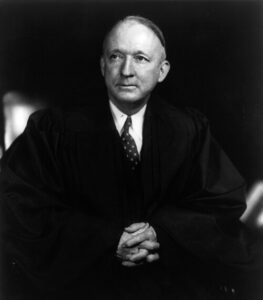
In 1947, the Supreme Court decided Everson v. Board of Education. The facts were unremarkable. New Jersey reimbursed parents for transportation costs to schools including religious schools. The Court upheld the policy.
But Justice Hugo Black’s majority opinion did something novel.
Black quoted a line from a private letter written by Thomas Jefferson in 1802, referring to a “wall of separation between church and state.” Jefferson had meant it as a reassurance to a religious minority that government would not interfere with belief.
Black transformed that metaphor into doctrine.
He declared that the Constitution erected a “high and impregnable wall” between church and state; language Jefferson never used, and the Constitution never contained.
This was not merely interpretive flourish. It was a reversal of direction.
What had once been a barrier protecting religion from government interference was reimagined as a barrier protecting government institutions from religious influence.
No amendment was passed. No public debate occurred. The words of the Constitution stayed the same. The meaning shifted.
From Limitation to Suspicion
After Everson, religion was no longer treated as a moral partner standing outside government authority. It became a constitutional problem to be managed.
This shift did not immediately remove religion from public institutions. Instead, it reclassified religion as suspect wherever the state was involved. That suspicion would soon be tested.
Engel v. Vitale: The Line is Drawn
In 1962, the Supreme Court decided Engel v. Vitale. New York had authorized a brief, voluntary, non-denominational prayer to open the school day. Students could opt out. No doctrine was taught. No church benefited.
The Court, Justice Black again, struck it down.
The ruling did not hinge on coercion. It hinged on state sponsorship. The problem was not belief, compulsion, or harm; it was the mere presence of a religious prayer.
With Engel, the Court established a decisive principle:
Religion could not play an official role in public moral formation.
Public schools, in particular, were now religiously sealed environments.
The wall Black had described was no longer metaphorical. It had become operational.
What No One Planned For
What followed was not immediately obvious, because removing something familiar does not announce what will replace it.
Public institutions, especially schools, cannot function without moral guidance. Children must still learn:
- how to behave
- how to resolve conflict
- how to exercise restraint
- how to relate to others
Religion had provided that vocabulary. Once excluded, another system had to take its place.
That system was psychology.
The Therapeutic Turn
Psychology offered an appealing solution. It claimed neutrality. It avoided theological dispute. It framed morality in terms of well-being rather than doctrine.
At first, this seemed humane.
But psychology beats to a different rhythm. It answers different questions than religion.
Religion asks: What is right?
Psychology asks: What is healthy?
Over time, moral language shifted accordingly.
Right and wrong were replaced with:
- healthy vs. unhealthy
- adaptive vs. maladaptive
- affirming vs. harmful
- safe vs. unsafe
This was institutional substitution.
Teacher training changed. Administrative language changed. Professional standards evolved. Emotional harm has become the dominant moral measurement.
Ethics had not vanished. It had been translated; redefined.
Why the Vacuum Could Not Stay Neutral
Once morality was framed in psychological terms, it became inherently contestable. Health, harm, and identity are interpreted differently by different theories. Unlike religious morality, psychology offers no external anchor, only models, frameworks, and outcomes.
This opened the door to competition.
Different systems began offering rival answers to moral questions:
- some emphasized power
- some emphasized perception
- some emphasized expression
- some emphasized autonomy
Each system claimed scientific or moral legitimacy. Each sought influence over institutions. Each framed itself as corrective to the others.
Ethics became a battlefield.
Institutions Like Arenas
Schools, courts, medicine, media, and universities became sites of moral struggle not because people suddenly lost values, but because no shared moral authority remained to adjudicate between claims.
Every disagreement became existential. Every boundary became political. Every moral question became procedural.
The center did not collapse. It was removed.
Why the Conflict Was Predictable
Once ethics was detached from a shared external reference point, it could no longer unify society. It could only manage disputes between competing frameworks.
This made the rise of modern “isms” inevitable.
They did not arise because religion failed.
They arose because religion was displaced without replacement.
Each “ism” captured a piece of moral truth and elevated it to supremacy.
That is why none of them can hold the whole.
Where This Leads
The moral confusion of the modern West is not accidental. It is the downstream consequence of a legal and institutional redefinition that relocated ethics from a shared moral source to a contested psychological terrain.
The question is no longer whether morality exists, but who gets to define it.
(This is the subject of the next chapter.)
Legal & Historical Footnotes (Endnotes)
- Everson v. Board of Education, 330 U.S. 1 (1947).Majority opinion by Justice Hugo Black; introduction of the “high and impregnable wall” language.
- Thomas Jefferson, Letter to the Danbury Baptist Association, January 1, 1802.The phrase “wall of separation between church and state” appears in private correspondence, not in constitutional text.
- Engel v. Vitale, 370 U.S. 421 (1962).Supreme Court decision prohibiting state-sponsored prayer in public schools, even when voluntary and non-denominational.
- James Madison, Memorial and Remonstrance Against Religious Assessments (1785).Foundational documents arguing against state-mandated support for religion reflect original Establishment Clause intent
- Fourteenth Amendment Incorporation Doctrine – see Gitlow v. New York, 268 U.S. 652 (1925), and subsequent cases.Basis for applying the Establishment Clause to state governments.
- Hamburger, Philip. Separation of Church and State. Harvard University Press, 2002.Scholarly analysis of the historical and legal evolution of separation doctrine.
- McConnell, Michael W. “Establishment and Disestablishment at the Founding.” William and Mary Law Review 44, no. 5 (2003). Detailed account of original Establishment Clause meaning.