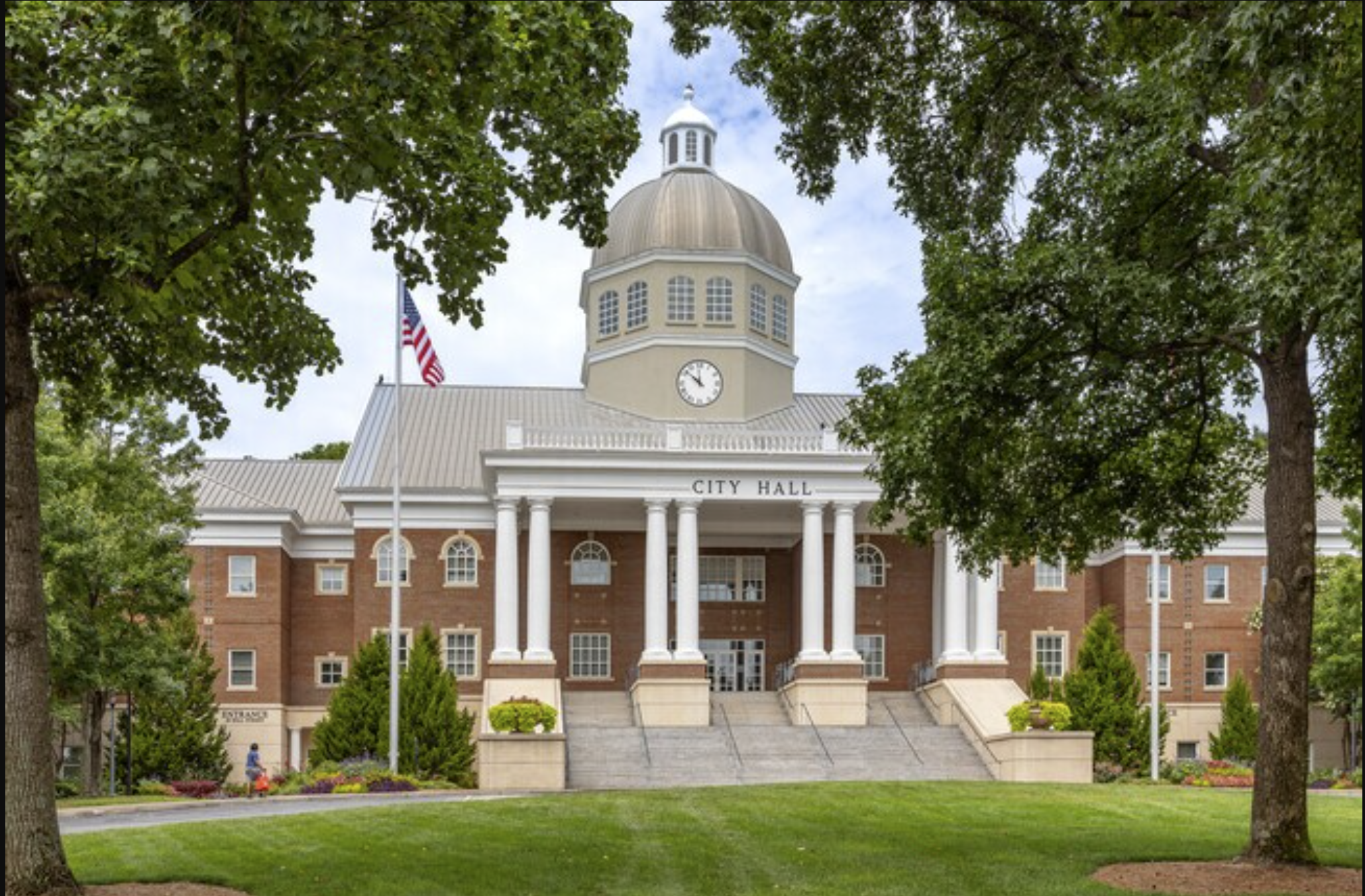
The Battle for the Suburbs

Faith, Funding, Zoning, and Political Influence in Metro Atlanta
Metro Atlanta’s northern suburbs are changing rapidly. Communities in Alpharetta, Johns Creek, Suwanee, Cumming, Forsyth County, and surrounding areas have seen significant growth in the South Asian population. With that growth has come greater cultural, religious, civic, and political influence.
New temples and cultural centers have become important gathering places for families. At the same time, disputes over zoning, traffic, development, religious freedom, campaign money, and political representation have created new tensions. The result is a growing debate over a simple but important question:
Who speaks for Georgia’s Hindu and South Asian communities—and what role should faith and identity play in American politics?
Temples, Growth, and Zoning Battles
Hindu temples are more than places of worship. They often serve as cultural centers, educational spaces, gathering places, and hubs for community events.
Major institutions, including the Hindu Temple of Atlanta in Riverdale and the BAPS Shri Swaminarayan Mandir in Lilburn, serve thousands of families. (Hinduism explained)
But as religious institutions expand into suburban communities, disagreements can arise.
Residents’ Concerns
Residents and homeowners’ associations often raise concerns about:
- Traffic and parking
- Large crowds during weekends and festivals
- Noise
- Infrastructure
- Neighborhood character
- The size and expansion of religious facilities
Temple organizations, however, may view these disputes differently. They can argue that zoning restrictions are being applied unfairly to religious institutions.
The Chinmaya Mission Dispute
One major dispute involved the Chinmaya Mission of Alpharetta and its property near Pittman Road.
The project faced strong opposition from neighboring residents and the Polo Golf & Country Club HOA. Concerns included the use of the property and the impact of weekend educational activities.
After years of legal and administrative disputes, the Forsyth County Board of Commissioners approved a court-sanctioned settlement.
Under the agreement, the organization accepted limits on future development for a period of time, while neighborhood lawsuits were withdrawn.
The Pilgrim Point Road Dispute
Another major controversy involved a proposed Hindu temple near Lake Lanier.
Forsyth County commissioners denied a permit for an approximately 11,200-square-foot temple in a residential area. Many local residents expressed concerns about traffic and the impact on the surrounding neighborhood.
RLUIPA
Temple organizers considered legal action under the federal Religious Land Use and Institutionalized Persons Act, commonly known as RLUIPA.
RLUIPA is a federal law designed to protect religious institutions from certain government land-use restrictions that may substantially burden religious exercise.
The central disagreement was clear:
Were local officials protecting neighborhood interests—or were zoning rules being used in a way that unfairly limited a minority religion’s ability to establish a place of worship?
The Political Fight Under Georgia’s Gold Dome
As the Hindu and South Asian communities have grown, their influence has increasingly reached the Georgia General Assembly.
Organizations including the Coalition of Hindus of North America, known as CoHNA, and other Hindu-American advocacy networks have supported efforts to address anti-Hindu discrimination and temple vandalism.
One major proposal was Senate Bill 375.
The legislation sought to establish a statutory definition of “Hinduphobia” within Georgia law. Supporters viewed the proposal as an important recognition of anti-Hindu discrimination.
The bill, however, did not become law.
Instead, Georgia lawmakers passed House Resolution 701, a non-binding resolution condemning anti-Hindu hate and temple vandalism.
The difference is important.
SB 375 would have created legal policy.
HR 701 is primarily symbolic and does not create new criminal penalties or enforceable legal requirements.
For supporters, the resolution represented recognition of concerns within the Hindu community.
For critics, the debate raised broader questions about how religious discrimination should be defined and whether such definitions could affect political speech or academic debate.
A Community with Different Political Voices
Georgia’s Hindu and South Asian communities are not politically uniform.
Like other large and diverse communities, they include conservatives, moderates, progressives, independents, immigrants, business leaders, professionals, students, and people with very different views about religion, India, America, and public policy.
That diversity is increasingly visible in Georgia politics.
The Conservative Network
Some Hindu-American political organizations support conservative candidates and Republican priorities.
Groups identified in the source include Americans4Hindus, the Hindu American PAC, and other politically active networks.
These organizations have supported candidates and issues involving:
- Religious freedom
- Recognition of anti-Hindu discrimination
- Merit-based immigration
- Public safety
- Business and economic issues
Republican figures such as Rep. Rich McCormick and Sen. Brandon Beach as political beneficiaries associated with parts of this conservative network.
Critics, including progressive advocacy organizations, argue that some political groups use the issue of “Hinduphobia” in ways that may also protect or advance broader ideological interests.
Those critics raise concerns about Hindutva, caste discrimination, human-rights debates, and political influence connected to India.
These are contested political allegations and should not be treated as established facts without independent evidence.
The Progressive Counterweight
Progressive South Asian political organizations have developed their own networks in Georgia.
The Indian American Impact Fund as a major force in progressive political organizing and voter mobilization.
Its priorities include:
- Voting access
- Immigration policy
- Reproductive rights
- Multi-racial political coalitions
- Broader civil-rights protections
The Democratic state senators including Nabilah Islam and Sheikh Rahman as part of the progressive political landscape.
This creates a growing competition—not simply between Republicans and Democrats, but between different ideas about what Hindu-American and South Asian political representation should mean.
The Debate over “Hinduphobia”
Few issues reveal the divide more clearly than the debate over the term “Hinduphobia.”
Supporters argue that Hindu Americans face genuine discrimination, online harassment, stereotyping, and occasional attacks on temples and religious institutions.
From this perspective, recognizing anti-Hindu hate is a necessary step toward protecting a religious minority.
Critics raise different concerns.
They argue that political definitions of “Hinduphobia” must be carefully written so they do not confuse legitimate criticism of governments, political movements, religious institutions, or ideologies with hatred against Hindu people.
The disagreement can be summarized this way:
Supporters say:
“Protect Hindu Americans from religious hatred and discrimination.”
Critics say:
“Protect Hindu Americans without creating rules that could discourage legitimate criticism or political debate.”
Both sides argue that they are defending civil rights—but they disagree about where those protections should begin and end.
Money and Political Influence
As the community’s political importance grows, campaign fundraising has also become more significant.
The conservative and progressive organizations competing to influence elections, candidates, legislation, and public opinion.
Political action committees and advocacy organizations can help communities organize around shared interests.
They may:
- Raise campaign funds
- Endorse candidates
- Organize voters
- Support legislation
- Hire lobbyists
- Conduct outreach in multiple languages
This is not unusual in American politics.
What makes Georgia increasingly important is the size and growth of its South Asian population and the political importance of suburban counties such as Fulton, Forsyth, and Gwinnett.
The growing influence of these voters means candidates from both political parties are paying closer attention.
Local Issues can Become National Debates
A dispute over a temple parking lot may appear to be a local issue.
A debate about a religious resolution may appear to concern only the Georgia General Assembly.
But these issues can quickly become connected to larger national and international debates involving:
- Religious freedom
- Civil rights
- Immigration
- Caste discrimination
- India-U.S. relations
- Hindu nationalism
- Campaign financing
- Political polarization
That is one reason these suburban disputes have attracted increasing attention.
Local zoning boards are now dealing with questions that can have national political consequences.
Why Georgia Matters
Georgia has become an important political testing ground.
The state combines several factors:
A rapidly growing Hindu and South Asian population
Metro Atlanta continues to attract professionals, entrepreneurs, physicians, engineers, technology workers, and families.
Politically competitive suburbs
Communities such as Alpharetta, Johns Creek, Suwanee, Cumming, and parts of Gwinnett and North Fulton sit within politically important regions.
Strong religious and cultural institutions
Temples and cultural organizations provide networks that can support civic engagement and political organizing.
Increasing competition for voters
Both conservative and progressive organizations recognize that South Asian and Hindu-American voters may play an increasingly important role in future elections.
The Road Ahead
The political and cultural debate within Georgia’s Hindu and South Asian communities is likely to continue.
More temples and cultural institutions may lead to more questions about land use and neighborhood development.
Future legislation may renew debates about religious discrimination and civil rights.
Campaign organizations will likely continue competing for the support of one of Georgia’s fastest growing and increasingly influential communities.
The most important challenge may be ensuring that political competition does not erase the diversity of the community itself.
There is no single Hindu-American political voice.
There is no single South Asian political agenda.
And there is no simple answer to the question of who represents such a large and diverse population.
Where Faith and Politics Intersect
What is clear is that Georgia’s suburbs are becoming an increasingly important place where faith, identity, money, law, and politics intersect.
The outcome will not be decided only at the Georgia Capitol or in Washington.
It will also be shaped in city council meetings, zoning hearings, neighborhood associations, temples, community organizations, and local elections.
The Bigger Question
Georgia’s future will depend on whether its growing communities can debate difficult issues without turning differences into permanent divisions.
Faith can build community. Politics can create influence. But democracy works best when disagreement does not become dehumanization.
The real battle for the suburbs may ultimately be about something larger than zoning, PAC money, or political ideology:
Can a rapidly changing Georgia build political power while still preserving pluralism, fairness, and mutual respect?